

Kennedy ‘deeply committed to ending animal experimentation’
HHS secretary vows to end U.S. monkey imports, push for retirement of research primates.
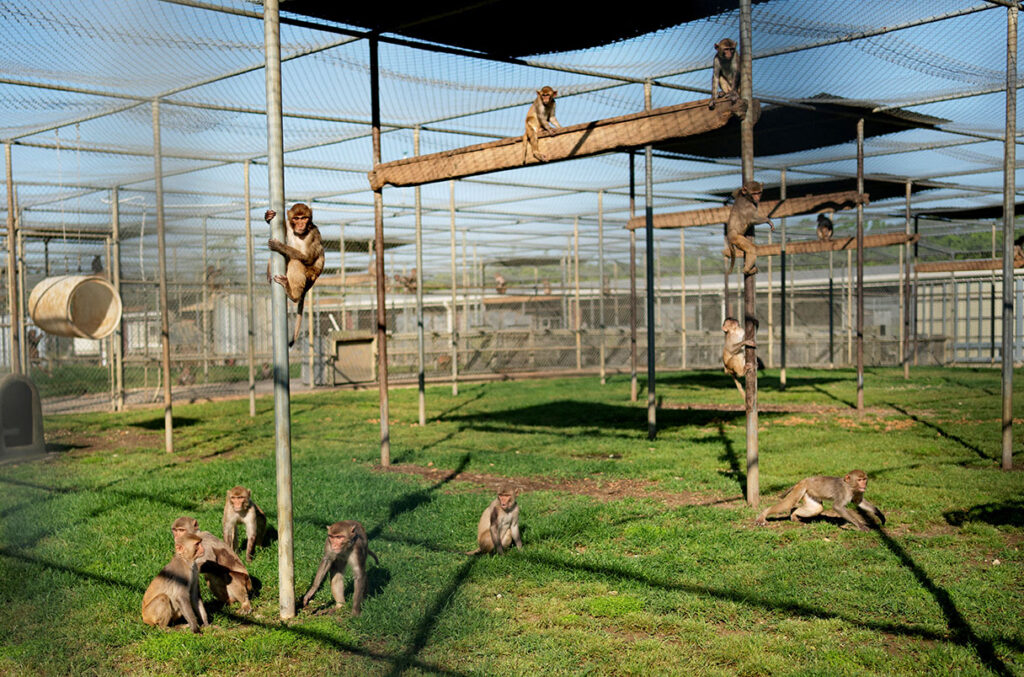
In his strongest condemnation yet of animal research, U.S. Department of Health and Human Services (HHS) Secretary Robert F. Kennedy Jr. said over the weekend that his department, which oversees several science agencies, is “deeply committed to ending animal experimentation.” He also called for an end to the importation of monkeys for scientific studies, claimed the federally funded National Primate Research Centers (NPRCs) are driven by profit, and floated the idea of moving research monkeys to sanctuaries. The remarks, made Saturday on a Fox News program hosted by the daughter-in-law of President Donald Trump, have sent shock waves through the biomedical community.
“What a disaster this would be for not only infectious disease, but also neuroscience, behavior, reproductive biology, and transplant research,” says JoAnne Flynn, a microbiologist at the University of Pittsburgh who uses nonhuman primates to study tuberculosis.
Leaders of the seven primate centers, all of which are funded by the National Institutes of Health (NIH), also pushed back.
Kennedy’s claims that NPRCs are driven by profit are “wrong and offensive to those who have dedicated their lives to helping others and providing care for the animals,” says Joyce Cohen, associate director of animal resources at the Emory NPRC. “It has taken decades to build the NPRCs into world-class facilities that … produce scientific advancements that save and improve human and animal lives.” She adds that her facility is committed to researching nonanimal approaches, but such models currently “cannot replicate the complexity of multiple systems working together in a living organism.”
Biomedical researchers who work with animals have been on edge since Trump took office for his second term in January. Over the past year, the Food and Drug Administration, the Environmental Protection Agency, and NIH have announced plans to reduce their reliance on animal studies.
Monkey researchers have been especially concerned. In 2023, a National Academies of Sciences, Engineering, and Medicine report concluded that the supply of nonhuman primates for biomedical research was at a crisis point, with access to animals from both domestic and foreign sources becoming unreliable. U.S. labs use about 70,000 monkeys a year; the shortage, researchers argued, was compromising studies on infectious diseases, neurodegenerative conditions, and vaccines. Lobbying efforts to get the United States to increase funding for NPRCs have been unsuccessful, however.
The concerns have intensified recently. Since last summer, rumors have swirled among researchers that the government is considering closing the NPRCs—which house about 20,000 animals used in academic labs—and converting them into sanctuaries, in part because private sanctuaries have no room. Then, last month the Centers for Disease Control and Prevention moved to phase out all of its monkey studies. And on Friday, a group of Republicans and Democrats in the U.S. House of Representatives sent a letter to NIH Director Jayanta “Jay” Bhattacharya, urging him to prioritize nonanimal models and reduce funding to the NPRCs.
Kennedy made his remarks during a pretaped segment of My View with Lara Trump titled “Ending Animal Abuse in America.” Seated between Secretary of Agriculture Brooke Rollins and Attorney General Pam Bondi, who condemned puppy mills and dog fighting, respectively, Kennedy said internal studies by HHS had concluded that “the predictivity of animal models is very, very poor for human health outcomes.” Nonanimal approaches such as artificial intelligence “are much better,” he said. “We’re re-educating researchers so that they know that there are these other forms of research that are much more predictive.”
Kennedy criticized nonhuman primate research in particular, saying the NPRCs had a “profit motive” that made them resistant to exploring nonanimal alternatives—echoing talking points made by animal rights groups. He also noted that the U.S. imports about 20,000 monkeys a year, which are largely used by private industry for drug and vaccine research. “We’re trying to put an end to that completely.”
Kennedy didn’t specify why he wanted to end monkey imports, but the animal rights group People for the Ethical Treatment of Animals (PETA) says it met with him in June to present evidence that foreign monkeys can carry tuberculosis, herpes, and other infectious diseases. “PETA applauds the secretary for speaking the truth and offering a way forward that will help human patients without caging and killing other primates,” the organization’s senior vice president, Kathy Guillermo, says.
An HHS spokesperson did not respond to a request for more details on Kennedy’s remarks. “Across the Trump administration, there is a shift to prioritize animal welfare,” the spokesperson told Science. “At HHS, that includes moves to reduce unnecessary animal testing requirements and prioritizing human-based research.”
The seven primate centers have an annual budget of more than $100 million. “Any cuts to the NPRCs would deliver a major setback to U.S. scientific progress,” Cohen says.
Jay Rappaport, director of the Tulane National Biomedical Research Center, another NPRC, warns the U.S. could regret closing these facilities if a new pandemic emerges. “We have to be ready for new biological and infectious disease threats, and we need to be able to compete with China,” he says. (China has been rapidly expanding its primate breeding and research facilities.) Still, Rappaport notes that his center has recently rebranded, replacing “primate” with “biomedical” to signal a more diverse focus on nonmonkey studies. “Nonhuman primate work is still a foundational pillar of our center, but we’re expanding into other areas.”
Sally Thompson-Iritani, the assistant vice provost responsible for the University of Washington’s animal care program, which includes its national primate center, suspects HHS might move to convert NPRCs into sanctuaries. That would take a commitment of somewhere between $6 million and $10 million a year for her NPRC alone, she says.
Earlier this month, Americans for Medical Progress—which advocates for animal research—sent a letter to NIH urging continued support for monkey studies. But Thompson-Iritani worries it may be too late. “Everyone’s nervous, she says. Whatever happens, Thompson-Iritani says, the welfare of any monkeys retired from research should be paramount. “I want to make sure the animals are taken care of,” she says. “That has to be part of the equation.”
Source: ScienceMag


 Власник сајта: HR2RENT - део слагалице који Вам недостаје