

How do busy bees avoid overheating from flying?
New measurements could help predict pollinators’ ability to withstand climate change
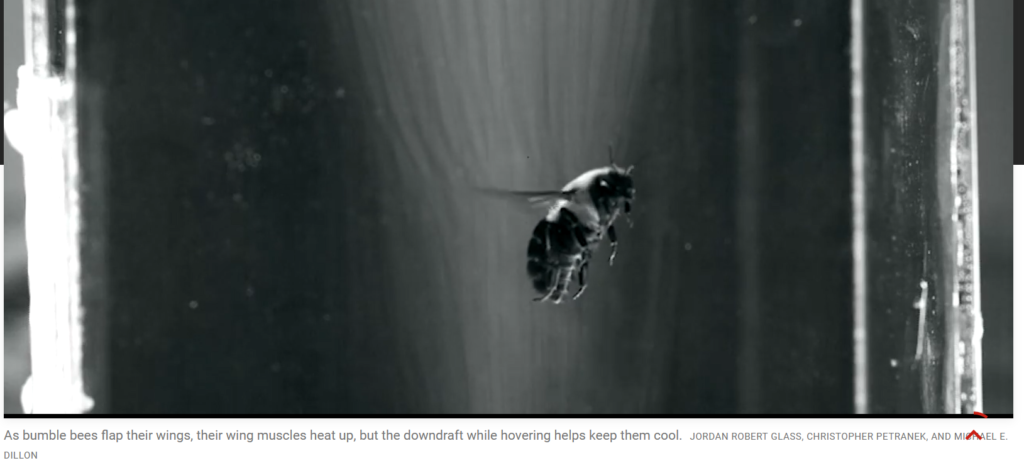
Bumble bees may look clumsy and goofy hovering above a flower, but don’t be deceived: They’re among the hot rods of the insect world and able to fly 22 kilometers per hour. Even while hovering, their powerful wing muscles generate a lot of heat. Like any high-performance vehicle, the bees have ways to keep their motors cool—and a new study shows just how effective one of these methods can be.
As a bumble bee hovers in place, the breeze it generates can lower the insect’s body temperature by 5°C, researchers report today in the Proceedings of the Royal Society B: Biological Sciences. The “whopping” magnitude of that cooling means this fanning effect is a big deal for a flying insect, says Art Woods, an insect physiologist at the University of Montana. He adds that by improving our understanding of how temperature affects bumble bees’ flight, the findings will allow scientists to better predict the ability of the insects to survive in a warming world.
Insect flight has fascinated scientists for a long time. Leonardo da Vinci studied dragonflies and designed a flying machine based on them. More recently, some biologists have focused on the effects of heat generated by flight muscles. On a cold morning, for example, insects warm up their flight muscles by flapping their wings; bumble bees can use this process to raise their body temperature more than 30°C above the ambient air. “Your car is warmed up and ready to go,” says Jordan Glass, an environmental physiologist at the University of Wyoming, lead author of the new bumble bee study.The latest news, commentary, and research, free to your inbox daily
In theory, this amount of metabolic power could limit bees’ ability to fly in hot weather. But bumble bees have several tricks to cool themselves, such as passing heat from their chests to their cooler abdomens via circulatory fluid called hemolymph. Researchers have studied this effect and other body temperature factors—such as warming from the Sun and evaporative cooling—to build what’s called a heat balance model of a bumble bee. But Glass realized this model was missing a piece: No one had measured in detail the cooling that comes from air flowing around a bumble bee’s body generated by its beating wings.
The first step was to figure out how fast that air is moving. A co-author put bumble bees into a chamber studded with air speed sensors. As bumble bees hovered over an artificial flower in the chamber, the researchers clocked the air moving at between 0.25 to 2 meters per second. Next, by putting dry ice in water in the chamber to generate a smokelike fog, the team determined the pattern of this airflow (see video, above).
To precisely measure this airflow’s cooling potential, Glass and his colleagues then euthanized 18 bumble bees. Into each they inserted a tiny temperature probe, heated the body to 50°C, and placed it into a wind tunnel that could mimic the air patterns and velocities the team had measured around a hovering bumble bee.
Glass and his colleagues estimate that without the cooling effect they measured, hovering bumble bees would overheat and drop out of the air in less than 2 minutes. In other lab experiments, Glass says, bees’ flight muscles showed they could experience a kind of mechanical failure, like a car overheating. But Glass adds that bees could potentially sense this threat—a kind of “check engine” warning in the brain—and land shortly thereafter to recover.
The team is the first to do such careful measurements of this wing-generated cooling effect, Woods says. Still, questions remain, such as the magnitude of cooling during forward flight, which is harder to measure in the lab than hovering. Sanjay Sane, who studies insect flight at the Tata Institute of Fundamental Research, suspects the cooling effect may only be significant while hovering. Woods speculates that during forward flight there may be less of a downdraft—an important source of cooling during hovering.
Glass is studying additional factors, such as how the hairs covering a bumble bee’s chest affect heat flow. His goal: to determine how vulnerable bees and other pollinators will be to overheating in a changing climate. “How durable are these animals? Can they pivot and roll with the punches to be able to persist in a changing world?”
doi: 10.1126/science.z2tzo84
Source: Science


 Власник сајта: HR2RENT - део слагалице који Вам недостаје