

Direct approach to laser-powered fusion promises simpler power production
Experiments suggest that, with enough laser power, “direct drive” technique should produce energy gain.
A simpler technique for generating fusion energy with lasers promises to make the approach much more cost effective—provided it can be scaled up.
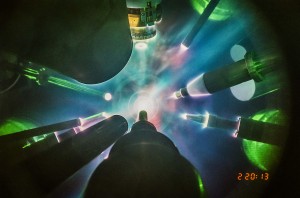 The advance, reported by a team using the Omega laser system at the University of Rochester (U of R), builds on the 2022 breakthrough in which the National Ignition Facility (NIF) sparked a nuclear fusion reaction generating more energy than the laser beams supplied to produce it. But by removing a layer of material—and hence complexity—from that technique the new “direct drive” approach may be better suited for future power production, researchers say.
“It’s a really significant result,” says plasma physicist Steven Rose of Imperial College London, who was not involved in the study.
Fusion promises bountiful, carbon-free energy by harnessing the nuclear physics that powers the Sun. The goal is to force nuclei of heavy hydrogen isotopes, deuterium and tritium, to fuse to produce a helium nucleus and a neutron. For decades, scientists have struggled to reach the temperatures of 100 million degrees Celsius or more required to produce this reaction. Many efforts use powerful magnetic cages called tokamaks and stellarators to trap and heat the fuel. In contrast, NIF at Lawrence Livermore National Laboratory uses lasers to implode a peppercorn-size fuel capsule until the pressure and temperature at its core ignites a fusion burn.
In December 2022, NIF researchers fired a 2.05-megajoule laser pulse that yielded 3.15 MJ of energy—equivalent to three sticks of dynamite, a result published today in Physical Review Letters. Although those numbers indicate fusion in the plasma generated more energy than the laser light pumped in, it required 150 times more energy to create the laser pulse.
The challenge for this type of fusion is to compress the fuel with perfect spherical symmetry. Any imperfections and the compressed gases will bulge out unpredictably, like a water balloon squeezed by a toddler, reducing the core temperature. Although NIF’s 192 beams converge on the fuel from all directions, researchers take an extra step to improve symmetry by surrounding the capsule with a cylinder of gold the size of a pencil eraser. The lasers heat the cylinder so it bombards the capsule with x-rays. The capsule’s thin diamond shell then vaporizes, blasting outward like a rocket engine and squeezing the fuel symmetrically inward. But this technique would likely be too costly for a gigawatt power plant, which would consume nearly 1 million gold cylinders and fuel capsules every day, and would need to clear away the debris from 10 shots every second.
The simpler direct drive approach does away with those gold cylinders, shining Omega’s 60 laser beams directly onto the tiny fuel capsule to vaporize it. Without the smoothing effect of x-rays, the team at U of R’s Laboratory for Laser Energetics (LLE) needs higher quality laser beams, with energy spread evenly across the wavefront, converging with perfect symmetry. In the recent shots, the team tweaked the design of the capsule, adding silicon to the polymer shell to improve energy absorption, explains LLE’s Varchas Gopalaswamy. And whereas NIF can fire about once per day, the smaller Omega can perform up to 10 shots per day, allowing LLE researchers to rapidly tune their setup.
However, Omega’s capsules are too small to achieve a burning plasma, which occurs when heat from fusion reactions within the plasma sustains more reactions—just as heat from a burning log sustains more combustion. So, the LLE researchers extrapolated from their results what they would have achieved if they’d used a larger capsule and a laser as powerful as NIF, using a mathematical technique called hydro-equivalent scaling. (Researchers can’t implement direct drive at NIF because it has a less symmetrical arrangement of lasers.)
The best performing shot, scaled up 4.2 times to NIF size, would have produced 1.6 MJ from a 2.15-MJ pulse, the researchers describe today in a pair of papers in Nature Physics. Although that isn’t energy gain, it would have created a burning plasma. The team hopes further tweaks will get them to shots that, if scaled up, would yield energy gain. “That’s our goal and we should achieve it without major modifications,” says LLE chief scientist Riccardo Betti.
That’s good news for those hoping to generate power with laser fusion, says Robbie Scott of the Rutherford Appleton Laboratory, because direct drive is five times more efficient than NIF at transferring power from the lasers into the fuel. In addition, Rose says, for direct drive “the targets are much simpler and potentially easier to manufacture.” Several startup companies are already working on schemes to commercialize the technology, and the Department of Energy is also backing such work. In December 2023 it announced a $42 million effort to create three multidisciplinary hubs devoted to laser fusion, including one led by LLE.
doi: 10.1126/science.zafh6c4
Source: Science


 Власник сајта: HR2RENT - део слагалице који Вам недостаје